‘The Electrification Institute is a "speed boat" for deep electrification’
The Electrification Institute is an ambitious initiative designed to bridge the gap between academic research and industrial application. In this interview Quinten Van Avondt, the Domain Manager for Sustainable Chemistry and Materials at the University of Antwerp, explains the university's strategy of deploying research teams as agile "speed boats" to accelerate innovation. From building unique pilot installations for methane pyrolysis to fostering industrial partnerships, Quinten shares how the Electrification Institute is facing the challenges of deep electrification head-on.
How did the idea for the Electrification Institute come about?
Quinten Van Avondt: ‘Under the leadership of Silvia Lenaerts, there has always been the idea of setting up a separate business unit to achieve things that are less obvious within a traditional academic context. The idea was to create “speed boats” of research teamswithin that business unit that show strong promise in translating research into socio-economically relevant applications. And thus also to collaborate very actively with industry.’
‘Antwerp Valorisation & Development (AVD) was given the mandate to create these speed boats within three domains: life sciences, sustainable chemistry and materials, and urbanisation/digitisation. BlueApp, Vaccinopolis and The Beacon were established as the physical realisations of these three domains. These are the same domains in which we want to create speed boats with research teams that we can support with people and resources so that they can act decisively and quickly to explore the market and collaborate with industry.’
‘In 2023, with vice-rector Steven Van Passel and AVD director Dirk Lanens in place, we shifted up a gear. Together with all researchers in sustainable chemistry and materials, we asked how we, as a university, could make a difference in this area and at the same time differentiate ourselves from what already existed. The aim was also to ensure internally that we could bring people together around a clear trend or market demand. We wanted to be ambitious and inspire people throughout the university with a powerful example. That ultimately became the Electrification Institute. What played a role in our choice was the strong track record of the three research teams that are today contributing to it. We are already seeing the positive effects of this strategy today with new teams working on chemical recycling (iPRACS), sustainability analyses (B.Cycle) and electron microscopy (EMAT).’
What exactly do you do within the Electrification Institute?
Quinten Van Avondt: ‘We bring together professors and their teams from relevant fields. We take specific technologies to a higher TRL level. In addition, we gather an advisory board of industrial companies around the research teams. The electrification technologies we have chosen have also been highlighted as next-generation technologies in numerous reports: plasma, electrochemistry and power-2-heat.’
Can you explain a little more about the choice of these three technologies?
Quinten Van Avondt: ‘When we talk about plasma, electrochemistry and power-2-heat — mainly through induction and resistive heating — as next-generation electrification techniques, we are explicitly focusing on 'deep electrification”. There is an important distinction with indirect electrification, which is already more widely used today. With indirect electrification, you try to make an existing process electric without drastically changing the process itself. A good example is generating process heat with electricity instead of burning gas.’

Direct or deep electrification aims to transform and innovate the processes themselves. So it's not just about generating heat electrically, but also intervening in the chemistry itself.
Quinten Van Avondt: ‘Direct or deep electrification aims to transform and innovate the processes themselves. So it's not just about generating heat electrically, but also intervening in the chemistry itself. We also refer to this as “electrification 2.0” to make that distinction clear. On the periphery, we are still working on indirect electrification at the university, because progress is still needed there too, but at a certain point, we believe that direct technologies will take over completely. Our scope within the institute therefore remains direct electrification. That is the basis on which we started, and that is how we want to distinguish ourselves.’
What do these partnerships with industry look like in concrete terms?
Quinten Van Avondt: ‘Between 2020 and 2024, there has been enormous growth in our activities around these themes. First and foremost, the Electrification Institute provides clarity to industry, which means we are also found more quickly when it comes to this deep electrification. Specifically, we have an advisory board of industrial companies. You can really sense that they want to be well informed about all the latest technological developments. The step from scouting to real collaboration takes time: trust has to grow. We are making progress with our academic track record which helps the dialogue with industrial partners move forward.’
At BlueApp, you are building pilot installations. How does that fit in with the plans of the Electrification Institute?
Quinten Van Avondt: ‘At BlueApp, we want to make pilot-scale test setups available for electrification 2.0. For each technology, we will have a test setup (TRL5-6) in our pilot hall: a plasma torch, an electrothermal fluidised bed reactor and a large CO2 electrolyser that we can use relatively flexibly to test components and validate process parameters on relevant scales.’
Is that comparable to what Bio Base Europe Pilot Plant does?
Quinten Van Avondt: ‘Bio Base Europe Pilot Plant (BBEPP) is a very inspiring example, but the situation is somewhat different for the technologies we are focusing on. What they are doing is certainly impressive, and our philosophy is essentially the same. Every technological development must go through the steps of upscaling: from lab to pilot to demo and industrial application. Each step becomes increasingly capital-intensive, while the risk remains relatively high for a long time. Shared assets can help to alleviate those heavy investments for more parties. The disadvantage for us is that the type of pilots we are building are inherently less flexible than BBEPP's bioreactors. Take our fluidised bed reactor, for example, which has now been commissioned for a single application: methane pyrolysis to solid carbon and turquoise hydrogen. This is a similar technology that ExxonMobil and BASF are going to demonstrate in Houston. It is a unique pilot for our region. If we are then asked whether we can also use that pilot for other applications, unfortunately it is not a given. Other applications often require a very specific solution, which means you quickly have to build a new unit to test it.’
‘This makes it more difficult to use an asset pool for direct electrification for many different applications and thus bridge the lab pilot demo phases. We continue to face these challenges. Flexibility is built into Bio Base Europe Pilot Plant, while we must make choices. The rate of depreciation is therefore also very different. From a purely business point of view, we are investing with greater uncertainty.’
Have the research groups now become an integral part of the institute?
Quinten Van Avondt: ‘No, we want to keep academic work separate from the work with industry within the electrification institute. There is, of course, dialogue, but research groups continue to operate independently. In valorisation processes, certain projects can develop within the electrification institute.’
'Within BlueApp, we do want to blur the boundaries between the research groups. When it comes to upscaling and placing something in a relevant configuration, there are always important similarities between the different applications. We want to accommodate that within the institute. For example, there is a support team of two project managers and two technicians who provide support from the institute, together with the dedicated researchers who carry out the project.’
‘We are building a common layer where we can consolidate and exchange common learnings. The university is also investing in this, independently of project funds. This allows the Electrification Institute to grow steadily.’
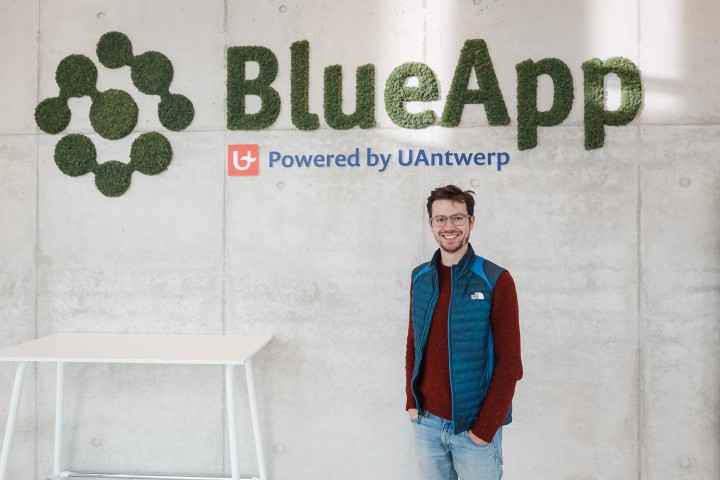
| Quinten Van Avondt is a domain manager sustainable chemistry and materials at Antwerp Valorisation & Development (AVD) at the University of Antwerp. Quinten started six years ago in this role in order to better define and delineate that domain within the university. At the same time, the construction of BlueApp was started and he was tasked with giving it meaningful substance by developing a strategy and putting together a team. We obtained funding from the European Regional Development Fund (ERDF) for the expansion of this campus. Once the Electrification Institute was established, Quinten also became its permanent representative. |
More info: electrificationinstitute.eu