SHERPA: request for industrial partners to join the industrial advisory board
SHERPA: Sorption Enhanced Hydrogen Production via Ammonia Decomposition. Request for Industrial Partners to join the Industrial Advisory Board
| Project ID | |
| Type | Intercluster Strategic Basic Research for clusters (cSBO) |
| Period | 01/01/2026-31/12/2029 |
| Starting date | 01/01/2026 |
| Total project budget | € 2.500.000 (estimated) |
| Subsidy percentage | according to SBO regulations |
| Industrial partners (Advisory Board) | Current partners not disclosed at the moment |
| Applicants (Knowledge partners) |
Universiteit Gent (coördinator) Von Karman Institute Vrije Universiteit Brussel |
| Catalisti contact | Mathias Jacobs (mjacobs catalisti.be (mjacobs[at]catalisti[dot]be)) and Dieter Ruijten (druijtencatalisti.be (druijten[at]catalisti[dot]be)) catalisti.be (mjacobs[at]catalisti[dot]be)) and Dieter Ruijten (druijtencatalisti.be (druijten[at]catalisti[dot]be)) |
Project description
Introduction
Ammonia is the world’s second most-produced chemical, with ~88% used in fertilizer production. As global energy systems decarbonize, ammonia decomposition offers a promising route for large-scale renewable energy transport and on-demand green hydrogen generation. When made with low-carbon hydrogen in regions rich in renewables (e.g., Australia, Chile), ammonia becomes an efficient hydrogen carrier.
Key advantages include:
- High hydrogen density,
- Low energy penalty (~16%) for decomposition,
- Minimal hydrogen contaminants compared to methane/methanol reforming and easy purification.
Scaling this technology faces challenges such as developing efficient catalysts for high-pressure use, designing energy-efficient reactors, and optimizing hydrogen recovery.
The SHERPA project tackles these issues through an innovative reactor, advanced multicomponent metal alloy catalysts, a temperature-pressure swing adsorption system powered by green electricity, and holistic process optimization. It also includes a techno-economic and life-cycle assessment of the full NH₃-to-H₂ pathway.
Goals
Ammonia is a promising liquid hydrogen carrier for the hydrogen economy, but challenges remain, high energy demands, poor heat transfer, and catalyst inefficiencies. The SHERPA project addresses these barriers through four key innovations:
- Efficient Heat Integration via Shockwave Reactor:
SHERPA introduces an electrified, patent-filed shockwave (SW) reactor that enables rapid, direct heating of NH₃, unlike conventional tube reactors that lose up to 20% energy through indirect heating. This design boosts thermal efficiency and catalyst performance. - Advanced Catalysts:
Typical NH₃ cracking requires >700 °C. SHERPA aims to lower this threshold by developing robust, low-cost, non-noble metal catalysts with high activity below 600 °C, 20-40 bar and long-term stability—overcoming the cost and deactivation issues of Ru-based catalysts. - Separation and Purification:
Fuel cell-grade H₂ requires NH₃ levels <0.1 ppm and energy-intensive H₂/N₂ separation. While PSA and NH₃ adsorption are proven for natural gas reforming, few solutions exist for NH₃-rich streams at 20-40 bar. SHERPA will develop new materials and processes to recycle unconverted NH₃ and efficiently recover H₂. - Process Efficiency at Scale:
Though NH₃ cracking is thermodynamically favored at low pressure, this requires costly H₂ recompression. SHERPA integrates NH₃ cracking, separation, and recycling into a holistic, energy-efficient system to maximize H₂ yield at industrial conditions.
A full process model (shown in Figure 1) will support techno-economic and life-cycle analysis, identifying optimal deployment scenarios based on market conditions and comparing SHERPA’s approach to other low-carbon H₂ options like blue hydrogen.
In SHERPA’s concept, liquid NH₃ from storage is preheated via heat exchange with reactor exhaust, cracked in the electrified SW reactor, and then routed through a separation system. H₂ is recovered, and unreacted NH₃ is recycled back to the reactor inlet.

Request
To foster interaction with the industry, the project partners are looking for companies that wish to be involved in this cluster strategic basis research (cSBO) project as part of an Advisory Board.
More specific, the project partners are searching for
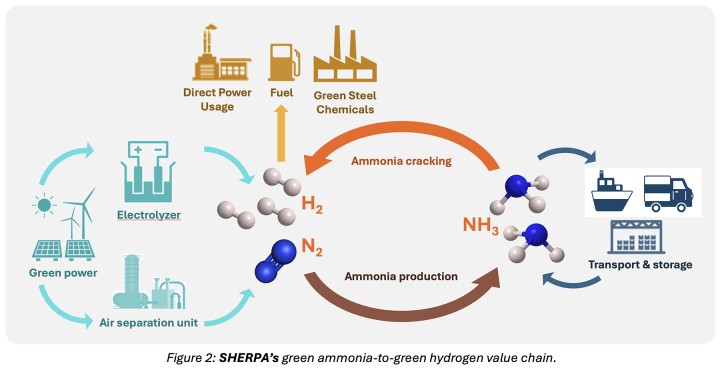
Companies with an interest in and which could benefit from the ammonia-to-green hydrogen value chain (figure 2). In other words, companies today active in or which have an interest in:
- Ammonia import;
- Ammonia storage & mainland distribution;
- Ammonia cracking;
- Hydrogen distribution;
- Hydrogen utilization (Energy industry, Petrochemical industry, Steel industry…).
The primary role of companies during the pre-project phase is to tailor the project proposal to the actual needs of the companies and thereby maximize the likelihood of future utilization of the results. During the project execution, a two-way dialogue between the researchers and the user field involved remains essential to achieve the targeted knowledge transfer from scientific research to concrete applications.
The primary role of companies during the implementation phase is:
- to assist the research activities from an economic point of view;
- to assist in designing and preparing the translation of the results into concrete economic applications.
During the cSBO project execution, companies may contribute as member of the Advisory Board. In addition, they may prefer to undertake parallel R&D activities that are related to the subject of the SBO project at their own expense. In the latter option, the parallel R&D activities are not part of the SBO project. Companies may explore the possibility to obtain funding from the Agency for Innovation and Entrepreneurship
The Advisory Board is open to all interested companies, including companies established outside the Flemish region.
Important notice: Companies that wish to be involved in this cSBO project, will need to be (at least) CONNECT member of Catalisti. For more information on membership and membership fees, please contact Mathias Jacobs (mjacobscatalisti.be (mjacobs[at]catalisti[dot]be)). In compliance to SBO regulations, the following requirements apply during the project implementation:
-
All commercial members of the advisory committee are required to make a monetary contribution of minimum € 250/year in the case of an SME or minimum € 1,000/year in the case of a large enterprise or another organisation.
-
A commitment to a substantive contribution and a time investment to participate in bilateral consultations with the project executors and/or meetings of the advisory committee.
How to reply to this request
Please send an email before 14/08 to Mathias Jacobs and Dieter Ruijten (mjacobscatalisti.be (mjacobs[at]catalisti[dot]be) & druijtencatalisti.be (druijten[at]catalisti[dot]be)) and briefly describe your interest and potential contribution to the project. After submission of your offer, you will be contacted for more information on the project contents, and a Letter of Intent and Questionnaire will be provided to join the Advisory Board of the project. Feel free to contact Mathias Jacobs (mjacobscatalisti.be (mjacobs[at]catalisti[dot]be)) for any further questions you might have related to this request.
Important notice: Partners that wish to participate in spearhead cluster-supported projects are required to be member of one of the spearhead clusters. For more information on membership and membership fees, please visit our website or contact Mathias Jacobs (mjacobscatalisti.be (mjacobs[at]catalisti[dot]be)).
Contact
Please contact Mathias Jacobs and Dieter Ruijten (mjacobscatalisti.be (mjacobs[at]catalisti[dot]be) & druijtencatalisti.be (druijten[at]catalisti[dot]be)) if you have questions concerning this RfP.
This Request for Partners is copyrighted by Catalisti vzw and its contents may not be reproduced without the prior written approval of Catalisti. This Request for Partners reflects the status of the proposed project on its date of release and the information contained herein may not be fully up to date or accurate. All information contained herein constitutes valuable information of Catalisti and may not be used for any purposes other than the evaluation of a person’s interest in participating in the proposed project.